REVIEW · HUE
Hue Imperial City Walking Tour maximum 12 pax
Book on Viator →Operated by Hue Vacations · Bookable on Viator
A trip to Hue can feel like a history lesson. This Imperial City walking tour turns it into a walk you can follow, with a tight route through the main gates and palace spaces of the Nguyen emperors. You’ll start at the cannons and move through the ceremonial core, with an English-speaking guide who explains how royal power looked, sounded, and worked in daily court life.
I especially like the small group size (max 12), which keeps the pace human and makes it easier to ask questions when something doesn’t make sense. I also love that the stops are practical landmarks you can picture later, like the Noon Gate and the big ceremonial palace. One thing to consider: there’s walking on uneven surfaces and some steps, so plan for comfort if you’re older, less steady on your feet, or traveling with someone who moves slowly.
You’ll also want to know up front that this tour is designed as a guided walkthrough, not a long self-guided wander. The guide packs in a lot of explanation along the way, which is great if you like detail, but it may feel like more than you expected if you prefer a lighter touch.
In This Review
- Quick hits before you go
- Why Hue’s Imperial City makes more sense on foot
- Small-group pacing at a practical walking speed
- Start point at the cannons: Cửa Ngăn and the opening story
- Nine Dynastic Cannons (Cửu Vị Thần Công)
- The ceremonial route: from Flag Tower to the Noon Gate
- The Flag Tower (Kỳ Đài)
- The Noon Gate (Cua Ngo Mon)
- Thai Hoa Palace: Supreme Harmony and major ceremonies
- Thai Hoa Palace (Palace of Supreme Harmony)
- Nine Dynastic Urns and Thế Miếu: state power plus worship
- Nine Dynastic Urns
- The Mieu Temple (Thế Miếu)
- Walking the Purple Forbidden City (Imperial Citadel)
- Hue Imperial City (the Citadel)
- Kien Trung Palace: the final chapter of the Nguyen dynasty
- Kiến Trung Palace (Kien Trung Palace)
- Royal spaces you can actually feel: corridors, quiet halls, theater
- Truong Lang (Long Corridor)
- Thai Binh Lau (Hall of Peace)
- Duyet Thi Duong Theater (Royal Theatre)
- Hien Nhơn Gate (Hien Nhon Gate)
- Price and value: what $18 buys you in Hue
- Practical logistics that keep your day smooth
- Who should book this tour
- Should you book Hue Imperial City Walking Tour with Hue Vacations?
- FAQ
- FAQ
- How long is the Hue Imperial City walking tour?
- What’s the maximum group size?
- Where do you meet the guide?
- Where does the tour end?
- Is an admission ticket included?
- Is the guide available in English?
- Do I need to print tickets?
- Is transportation included?
- Is bottled water provided?
- What’s the cancellation policy?
Quick hits before you go
- Max 12 people means you’re not lost in a crowd at the gates and palaces.
- English-speaking guide gives context for royal culture as you move between key spots.
- Most admissions included for many major stops, so you’re not constantly checking ticket counters.
- Mobile ticket simplifies entry on-site.
- You start at Ngan Gate (Cửa Ngăn) and finish at Hien Nhơn Gate area (Cửa Hiển Nhơn), so plan your next stop accordingly.
Why Hue’s Imperial City makes more sense on foot

Hue’s imperial complex is large, but it’s also very structured. On a walking tour like this, you get the logic of the space fast: where the emperor could go, where ceremonies happened, and where the court moved through controlled passages. Instead of just seeing walls and roofs, you’re learning how the layout signaled rank.
A big part of the value is timing. In about 2 hours 30 minutes, you cover the most important nodes: gates, ceremonial buildings, worship spaces, and later palace additions. It’s the kind of route that helps you connect what you see from the outside with what you’re told inside.
And it’s not just “look and listen.” The Imperial City is built to guide movement. When you walk it in the right order, doors, corridors, and courtyards start to feel like a system, not random stops.
Other Imperial City and Citadel tours in Hue
Small-group pacing at a practical walking speed
This tour is capped at 12 travelers, which changes everything. You can hear your English-speaking guide without straining, and you can ask questions without waiting for the group to catch up. It also makes it easier for the guide to tailor the flow if people are moving slower in certain areas.
Still, be realistic about the physical side. Expect uneven steps and ground that can be tricky in places. I’d treat this as a moderate walking experience. If you’re with someone who’s 60+ or less steady, choose shoes with grip and take it slow at the transitions between buildings.
Start point at the cannons: Cửa Ngăn and the opening story
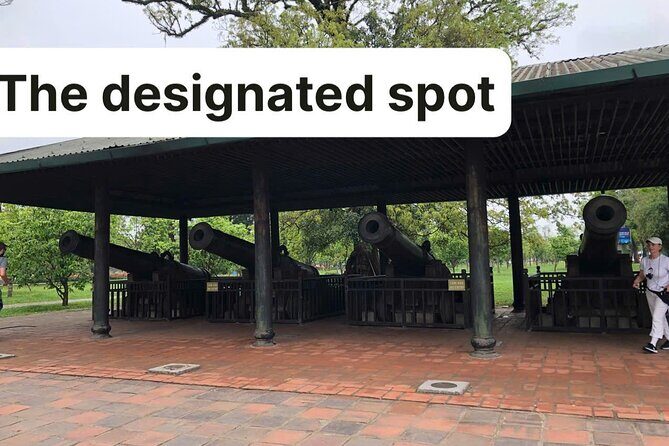
You meet at Cửa Ngăn (Ngan Gate) at the four cannons area. That matters because it anchors the entire tour in one theme: power, protection, and royal authority shown in objects you can see up close.
Nine Dynastic Cannons (Cửu Vị Thần Công)
The tour begins at the Nine Dynastic Cannons, cast during Emperor Gia Long’s reign (1803 to 1804). Bronze cannons like these aren’t just military hardware. They’re also visual statements of state capability and dynastic order.
You’ll hear how these cannons fit into the imperial landscape and why they were built when they were. The benefit here is momentum: you start with something dramatic and physical before moving into the ceremonial architecture.
One practical plus: admission is included at this first major stop, so you can focus on listening instead of managing tickets immediately.
The ceremonial route: from Flag Tower to the Noon Gate
After the cannons, the tour moves to the places where the court’s public-facing authority played out.
Other walking tours we've reviewed in Hue





The Flag Tower (Kỳ Đài)
The Flag Tower is tied to major Nguyen Dynasty events, including festival ceremonies, celebrations, and public announcements. The key idea I like is that it explains how “communication” worked at court—these weren’t just private moments. The dynasty used specific sites to mark important days and deliver messages.
This stop is short, but it sets up what comes next: gates and spaces designed to separate emperor from everyone else.
The Noon Gate (Cua Ngo Mon)
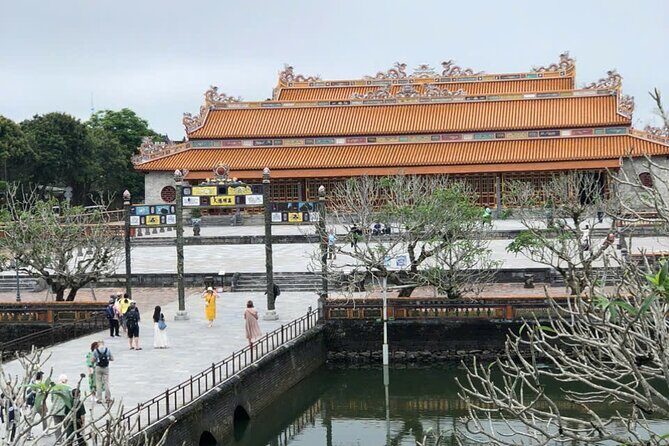
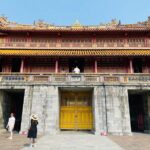
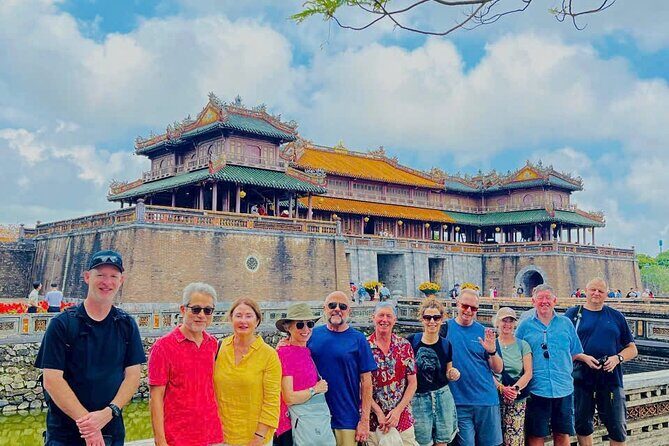
Then you reach the Noon Gate, the main gate of the Imperial City. Here, the big lesson is exclusivity. It was for the emperor and the royal entourage, not for general movement.
You’ll also get a sense of endurance. The architecture has withstood time and war, which helps you understand why these gates are treated as symbols of imperial identity. Short stop, high impact.
Thai Hoa Palace: Supreme Harmony and major ceremonies
From the gates, you shift into the ceremonial center.
Thai Hoa Palace (Palace of Supreme Harmony)
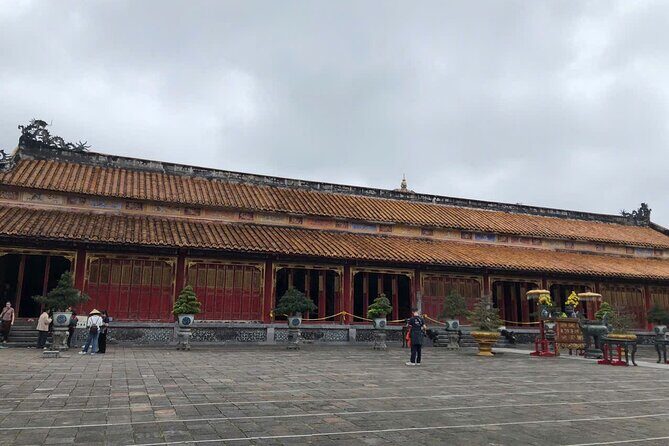
Thai Hoa Palace is described as the most important palace inside the Imperial City, used for key imperial ceremonies. The name alone signals how the court wanted the world to feel: order, control, and harmony, staged through ritual.
When you’re standing there, the value is in the guide’s explanation of what ceremonies were for and why that palace was chosen for them. It’s the kind of stop where you’ll stop seeing a building and start picturing a moment in time.
Admission is included here, so again, you’re not distracted by extra costs.
Nine Dynastic Urns and Thế Miếu: state power plus worship
After the main ceremonial palace, the tour adds two stops that balance politics with belief.
Nine Dynastic Urns
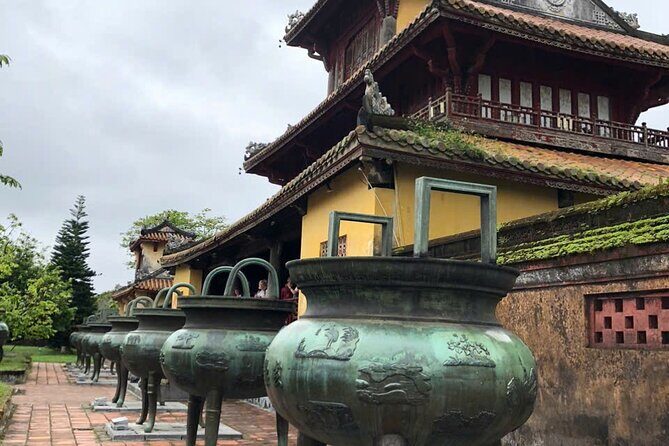
The Nine Dynastic Urns were constructed under Emperor Minh Mang between 1835 and 1837. Each urn is about 2.3 meters tall, and the tour highlights their heavy scale (the provided details describe weights between 1.9 to 2.6 in the official figures).
This is one of those stops where you see size and think, okay, this wasn’t meant to be temporary. The guide helps you read the urns as part of the state’s message: monumental, permanent, and tied to dynastic continuity.
Admission is included, which makes it an easy stop to justify.
The Mieu Temple (Thế Miếu)
Built in 1804, Thế Miếu served as a worship place for the Nguyen emperors and their queens. It also honors important officials linked to the Nguyen Lords’ reign.
This is where the tour feels more human. Instead of only military or political power, you see how the court connected religion, legitimacy, and memory. It’s also a good pause in the route—short, focused, and easy to absorb before you enter the deep core spaces.
Walking the Purple Forbidden City (Imperial Citadel)
This is the main highlight area for many people, and the tour keeps you moving in a way that makes the boundaries clear.
Hue Imperial City (the Citadel)
Inside the Imperial City, the guide frames the Purple Forbidden City as the highest authority space, reserved for the emperor and his royal family. It’s also noted as the third level of the Imperial City, which helps you understand that the complex was built like layers of privilege.
When you walk through this section with the guide’s explanations, it’s easier to feel the distance between public and private life at court. You’re not just passing buildings; you’re moving through controlled hierarchy.
Admission is included at this stop, so it’s worth giving your full attention here instead of rushing.
Kien Trung Palace: the final chapter of the Nguyen dynasty
The tour then moves forward in time to a later royal residence.
Kiến Trung Palace (Kien Trung Palace)
Kien Trung Palace was built in 1923 during Emperor Khai Dinh’s reign. It was the residence of the last two emperors of the Nguyen Dynasty: Khai Dinh and Bao Dai.
I like this stop because it prevents the tour from becoming stuck in the past-only story. You’re still in the Imperial complex, but now the focus shifts to the end stage of the dynasty. The guide helps connect why this residence matters, not just that it exists.
Admission is included, and the visit fits well after the older, more ceremonial spaces.
Royal spaces you can actually feel: corridors, quiet halls, theater
After the palace core, the tour includes several stops that are smaller but memorable. These spaces help explain the everyday rhythm of court life: movement, rest, and performance.
Truong Lang (Long Corridor)
The Truong Lang is a system of long corridors within the Forbidden Purple City. The guide explains how these corridors helped with communication and movement across the palace spaces. The point is simple and powerful: the court’s design was meant to control flow.
Even if you’re not a “corridor person,” this stop can help you understand how the complex works as a layout. It makes later buildings easier to interpret because you start noticing how space channels people.
Admission is noted as free for this stop.
Thai Binh Lau (Hall of Peace)
Next is the Hall of Peace (Thai Binh Lau), also described as Thai Binh Palace. This is presented as a calm retreat for the emperor to rest, reflect, and even compose poetry.
This is one of the most interesting emotional shifts on the route. After gates and ceremony, you get a space that’s explicitly about private mental life. The guide’s framing helps you understand that royal power wasn’t only public spectacle—it also needed a place to pause.
Admission is free here.
Duyet Thi Duong Theater (Royal Theatre)
The tour finishes this section at the Duyet Thi Duong Theater, one of four Nguyen Dynasty theaters used for cultural performances. It’s described as a place for artistic expression and part of the spiritual/cultural life of the court.
If you enjoy how governments use culture to project identity, this is worth your attention. It’s a reminder that the court wasn’t only about rituals of authority—it also staged art and performance in dedicated spaces.
Admission is included.
Hien Nhơn Gate (Hien Nhon Gate)
Finally, you reach Hien Nhơn Gate, on the eastern side of the Imperial City. Built in 1805 and later renovated under Minh Mang and Khai Dinh, it’s described as one of the most beautiful gates. The tour treats it as a fitting close to a route that began with visible power and ends with architectural statement.
This stop is marked as free. And since it’s also where the tour area ends, it can help you choose where to go next without backtracking.
Price and value: what $18 buys you in Hue
At $18 per person for about 2.5 hours, the value depends on what you like: guided interpretation or self-paced wandering.
Here, a key value lever is that many major stops include admission tickets. You’re seeing the cannons, major gates, the main ceremonial palace, the urns, worship temple, and the theater—all with guidance and included entry where noted. That reduces the “hidden cost” feeling you can get on tours where you pay for nearly everything yourself.
Another value lever is time. The route is tight but not rushed, and the small group size helps you get explanations without feeling like you’re in a cattle line.
What’s not included is also important: you’ll handle your own transport to and from the meeting point, and bottled water isn’t included. Bring water or plan a quick buy nearby. Also, wear shoes you can walk in for uneven steps.
Practical logistics that keep your day smooth
Here are the details that matter most in the real world.
- Mobile ticket: you’ll use it at entry as needed, which saves time at busy moments.
- Meeting point: the guide meets you at the four cannons at Ngan Gate (Cửa Ngăn).
- End point: the tour ends at Cửa Hiển Nhơn area.
- Confirmation: you should expect confirmation within 48 hours based on availability.
- Group max 12: it’s capped, which is why the tour feels controlled rather than chaotic.
- Weather: Hue can be hot and humid. This is outdoors walking, so start early and hydrate.
If you care about comfort, arrive a few minutes early and don’t overpack your bag. You’ll be moving between gates and buildings, and you’ll enjoy the explanations more if you can stand comfortably when the guide stops.
Who should book this tour
This one fits best if you want structure. If you’re the type who likes knowing what you’re looking at—especially how the Nguyen court used gates, palaces, corridors, and performance spaces—this tour is a strong match.
It’s also a good choice for first-timers to Hue who want the “big map points” without spending the whole day wandering. The small group format helps if you want more personal attention rather than a big bus feel.
If you’re traveling with someone with limited mobility, you can still consider it, but plan carefully. The uneven steps are a real factor, so shoes, pacing, and willingness to slow down matter.
Should you book Hue Imperial City Walking Tour with Hue Vacations?
If you want a guided route that makes Hue’s royal complex click, I’d book it. The combination of small group size, English-speaking guide, and admissions included at many key stops gives you solid value for the time. You get the ceremonial core, then the quieter and more personal spaces like the Hall of Peace, plus a later “end chapter” stop at Kien Trung Palace.
I’d hesitate only if walking on uneven steps is a serious problem for you or your group. This is not the kind of tour where you can fully avoid the ground realities of old stone and gate-to-gate movement.
FAQ
FAQ
How long is the Hue Imperial City walking tour?
It runs for about 2 hours 30 minutes.
What’s the maximum group size?
The tour has a maximum of 12 travelers.
Where do you meet the guide?
You meet at the four cannons at Ngan Gate (Cửa Ngăn) in Hue.
Where does the tour end?
It ends at the Cửa Hiển Nhơn area.
Is an admission ticket included?
Admissions are included for several main stops on the route, while a few stops are marked as free.
Is the guide available in English?
Yes, the tour includes an English-speaking guide.
Do I need to print tickets?
No. The tour uses a mobile ticket.
Is transportation included?
No. Transportation to and from the meeting point is not included.
Is bottled water provided?
No, bottled water is not included.
What’s the cancellation policy?
You can cancel for a full refund if you cancel at least 24 hours before the experience’s start time, based on local time.
You Might Also Enjoy



More Tours in Hue
- Easy Rider private tour via Hai Van pass from Hue – Da Nang – Hoi An (1Way|Loop)
★ 5.0 · 1,542 reviews



More Tour Reviews in Hue
- Easy Rider private tour via Hai Van pass from Hue – Da Nang – Hoi An (1Way|Loop)
★ 5.0 · 1,542 reviews